
What Is the Most Dangerous Fat on Your Body and How to Reduce It
This content was reviewed by Dr. Anthony Marotta, PhD to ensure alignment with current nutrition science
and evidence‑based education principles.
The most dangerous fat on your body isn't the belly fat you can pinch, it is visceral fat, which is stored deep inside the body, surrounding internal vital internal organs like the liver, pancreas and intestines. If you are concerned about the health risks associated with body fat, understanding visceral fat is crucial.
This article is designed for individuals who want to learn about the health implications of different types of body fat, especially those who are interested in reducing their risk of chronic diseases such as heart disease, diabetes, and cancer. We will cover what visceral fat is, why it is considered the most harmful, how to measure it, the health risks it poses including its link to certain cancers and effective strategies to reduce it. You’ll also learn how to distinguish visceral fat from subcutaneous fat, how to assess your own risk, and what lifestyle changes can help you achieve better health and longevity.
Understanding visceral fat matters because it is not just about how much fat you have, but where it is stored and how it behaves in your body. Visceral fat is often called 'active fat' because it surrounds internal organs and actively influences body functions. The body stores fat in different locations, and this fat storage pattern has profound implications for health.
This article will help you recognize the dangers of visceral fat, how to identify if you have too much, and what you can do to reduce it for better health and longevity.
Key Takeaways
Visceral fat, stored deep inside the abdomen around internal organs, is the most dangerous type of fat due to its biological activity and location.
Excess visceral fat increases risk factors for heart disease, stroke, type 2 diabetes, certain cancers (including breast cancer), and other chronic conditions.
Waist circumference is a practical measure to estimate visceral fat; a waist size over 35 inches for women and 40 inches for men indicates excess visceral fat.
Visceral fat acts as an endocrine organ, releasing harmful substances that promote inflammation, insulin resistance, and high blood pressure.
Lifestyle changes such as regular physical activity, healthy eating, adequate sleep, and stress management are effective strategies to reduce visceral fat and improve overall health.
This article focuses on nutrition, lifestyle, and wellness‑oriented education and does not provide medical treatment or individualized medical advice.
Table of Contents
Why Visceral Fat Is Considered the Most Harmful
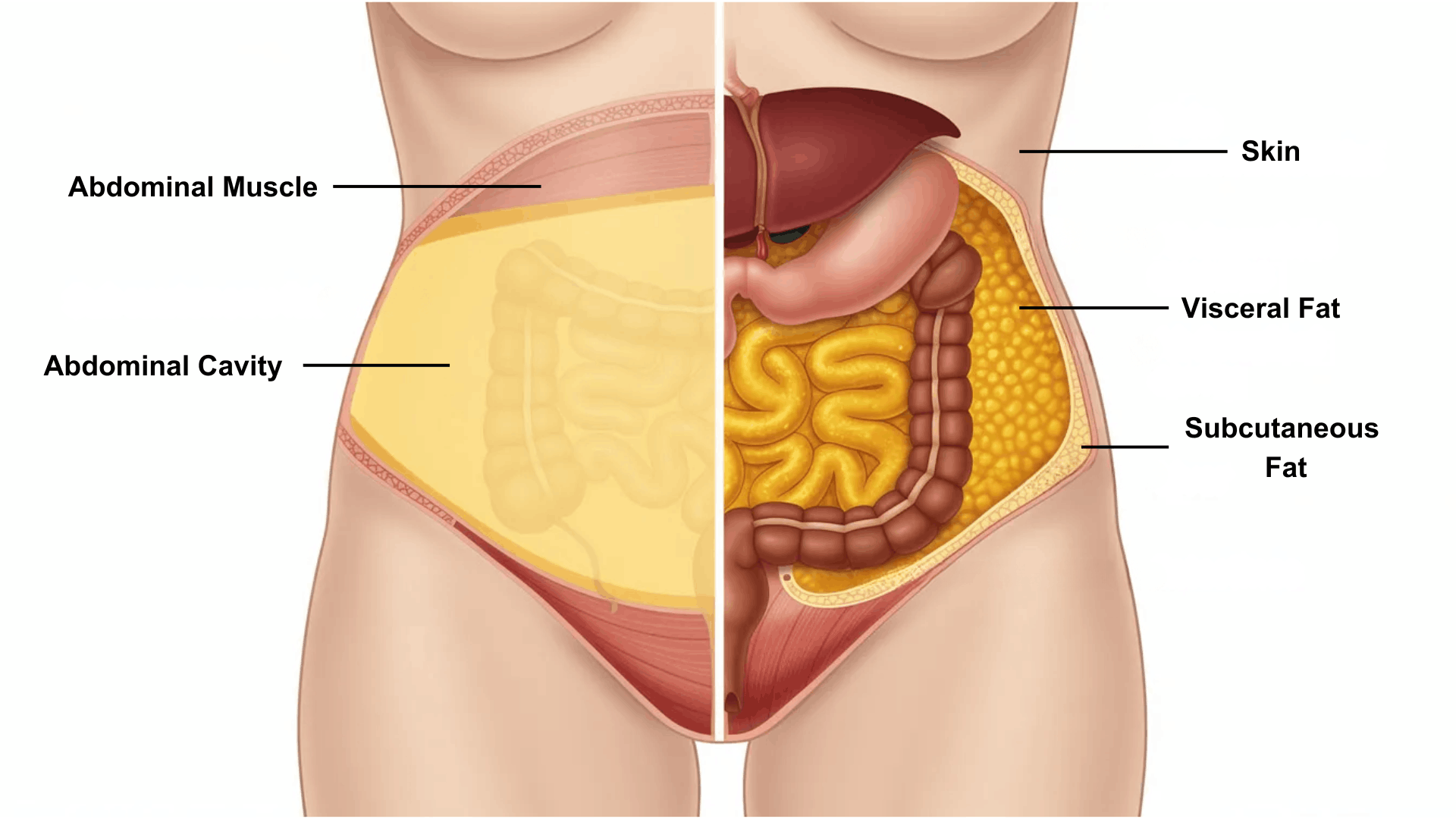
It is not simply how much fat a person carries that matters, but where that fat is stored.
Visceral fat is considered particularly harmful because of both its anatomical location and its biological activity. Visceral fat acts as an endocrine organ, secreting hormones and chemicals that influence other tissues throughout the body. Unlike subcutaneous fat, visceral adipose tissue lies deep within the abdominal cavity and directly surrounds internal organs and major blood vessels. This positioning allows visceral fat to exert a disproportionate influence on metabolic, inflammatory, and vascular processes [1,3,16].
A defining feature of visceral fat is that it drains primarily into the portal circulation, delivering free fatty acids and bioactive molecules directly to the liver. In addition, visceral fat makes and releases substances, such as cytokines and hormones, that can be toxic to the body. Visceral fat produces more toxic substances than subcutaneous fat, increasing its harmful effects on health. This pathway uniquely links visceral fat to disturbances in lipid metabolism, insulin signaling, and systemic inflammation [2,3].
Next, let's explore the specific health risks associated with excess visceral fat.
Visceral Fat as an Endocrine and Immune Organ
Fat cells, especially visceral fat cells, are biologically active and secrete hormones that can affect health. Visceral fat cells are biologically active and function as endocrine and immune cells. Compared with subcutaneous fat, visceral adipose tissue secretes higher levels of:
Pro‑inflammatory cytokines (e.g., interleukin‑6, tumor necrosis factor‑α)
Adipokines that interfere with normal metabolic signaling
Free fatty acids that flood the liver and impair lipid regulation
Together, these factors promote insulin resistance, dyslipidemia, endothelial dysfunction, and high blood pressure, contributing to cardiometabolic disease [2–4].
Now that you understand why visceral fat is so harmful, let's look at the specific health risks associated with having too much of it.
Health Risks Associated With Excess Visceral Fat
High levels of visceral fat are consistently associated with a wide spectrum of adverse health problems, including:
Heart disease and stroke, driven by effects on blood vessels, blood pressure, and lipid metabolism [1,4,16]
Type 2 diabetes and insulin resistance [5,10]
Metabolic syndrome, defined by abdominal obesity, dyslipidemia, hypertension, and impaired glucose regulation [3,15]
Colorectal cancer and breast cancer, particularly in women with central obesity [4,5]
Increased risk of surgical and anesthetic complications, as excess visceral fat can obscure internal anatomy and alter physiological responses during procedures [7]
Impaired lung function, asthma, sleep disturbances, gastroesophageal reflux, and increased all‑cause mortality through its role in chronic inflammation and multi‑system disease [16,17,12]
People with too much visceral fat are at greater risk for these health problems. Accumulation of visceral fat can also lead to premature death due to its association with various chronic diseases.
Now that you know the risks, let's compare visceral fat with subcutaneous fat to understand their key differences.
Subcutaneous Fat vs Visceral Fat: Key Differences
Subcutaneous Fat
Subcutaneous fat is located directly beneath the skin, above the abdominal wall. It is soft, pinchable belly fat and serves primarily as energy storage, insulation, and cushioning. While excess subcutaneous fat may reflect overall obesity, it is metabolically less harmful than visceral fat and, in moderate amounts, may even have neutral or protective metabolic effects [8].
People who store more subcutaneous fat often have a pear‑shaped body, which is associated with a more favorable cardiometabolic risk profile.
Visceral Fat
Visceral fat lies beneath the abdominal wall and abdominal muscles, deep in the abdominal cavity, where it surrounds internal organs. The body tends to store fat as visceral fat in the abdominal cavity, surrounding organs, and this storage pattern is linked to increased health risks. It is firm, not pinchable, and commonly associated with an apple‑shaped body. Despite accounting for only about 10% of total body fat in metabolically healthy individuals, visceral fat has a disproportionately large impact on health [3]. Individuals with the most visceral fat are at significantly higher risk for heart disease, dementia, and cancer.
Men tend to accumulate more visceral fat than women, although this difference narrows with age, hormonal changes, and lifestyle factors [14].
Understanding these differences helps you identify which type of fat poses the greatest risk and why targeting visceral fat is so important.
Next, let's look at how to determine if you have too much visceral fat.
How Much Visceral Fat Is Too Much?
Waist Circumference: The Most Practical Measure
The simplest and most clinically useful way to estimate visceral fat is by measuring waist circumference using a tape measure.
A waist circumference greater than:
35 inches (88 cm) in women, or
40 inches (102 cm) in men
is commonly associated with excessive visceral fat and increased cardiometabolic risk [7,18].
Measurements should be taken at the level of the hip bone or belly button, with the tape snug but not compressing the skin. Individuals with the least abdominal fat generally have the lowest risk of chronic disease.
Additional Assessment Tools
Waist‑to‑hip ratio provides insight into central fat distribution and body shape.
Body mass index (BMI) is useful at the population level but cannot distinguish visceral from subcutaneous fat and may underestimate risk in normal‑weight individuals.
CT or MRI imaging is the gold standard for directly measuring visceral fat, but is reserved for clinical or research settings [7,13,18].
Knowing how to measure visceral fat is the first step toward managing it.
Next, let's discuss effective strategies to reduce visceral fat.
Effective Strategies to Reduce Visceral Fat

Reducing visceral fat requires a multi‑component, lifestyle‑based approach rather than any single intervention. Strategies to lose weight and achieve a healthy weight are important for reducing visceral fat. Adopting a healthy lifestyle supports weight management, helps prevent visceral fat accumulation, and promotes long‑term reductions in abdominal fat.
Clinical evidence consistently shows that visceral fat responds favorably to caloric balance, physical activity, improved dietary quality, adequate sleep, and stress reduction, often more readily than subcutaneous fat [1,16]. A healthy diet is a key component to lose belly fat and visceral fat, and making dietary changes can help you lose weight and reach a healthy weight.
Physical Activity
Regular physical activity is one of the most effective strategies to reduce visceral fat.
Aerobic exercise, such as brisk walking, cycling, or swimming, preferentially reduces visceral fat even in the absence of large weight loss [9,16].
Resistance training supports muscle mass, improves insulin sensitivity, and enhances long‑term metabolic rate.
Combining aerobic and resistance training yields the greatest benefit [9,16].
Localized or “spot‑reduction” exercises strengthen abdominal muscles but do not selectively reduce visceral fat.
Healthy Eating and Dietary Quality
Dietary quality not simply calorie restriction is a key determinant of visceral fat accumulation.
Dietary patterns associated with less visceral fat include:
Reduced intake of processed foods, trans fats, partially hydrogenated oils, and foods sweetened with high‑fructose corn syrup, as trans fats and refined sugars can contribute to the accumulation of visceral fat
Limiting refined carbohydrates, refined sugars, and added sugars
Emphasizing whole foods such as vegetables, fruits, whole grains, legumes, lean protein, and unsaturated fats
Mediterranean‑style dietary patterns are consistently associated with less visceral fat and reduced cardiovascular disease risk [7,8]. Low‑fat dairy products may be included as part of a balanced diet, but no single food or food group alone is sufficient to reduce visceral fat without overall dietary improvement [9].
Sleep, Stress, and Hormonal Regulation
Chronic sleep deprivation alters cortisol secretion, insulin sensitivity, and appetite‑regulating hormones in ways that promote central fat accumulation. Adults sleeping fewer than six hours per night tend to have significantly higher levels of visceral fat [10,11].
Psychological stress also contributes to visceral fat accumulation through activation of the hypothalamic‑pituitary‑adrenal axis. Stress‑reduction practices, including mindfulness and yoga, may support visceral fat reduction when combined with diet and exercise [12].
By implementing these strategies, you can take meaningful steps toward reducing visceral fat and improving your overall health.
Next, let's look at the long-term benefits of reducing visceral fat.
Long‑Term Benefits of Reducing Visceral Fat
Sustained reductions in visceral fat are associated with:
Lower risk of developing heart disease and stroke
Improved insulin sensitivity and reduced risk of type 2 diabetes
Reduced cancer risk, particularly colorectal and post‑menopausal breast cancer
Improved blood pressure, cholesterol levels, and blood vessel function
Enhanced functional capacity, health span, and longevity [16,17]
These benefits often occur independent of large changes in body weight, reinforcing the importance of targeting visceral fat directly.
Now that you know the benefits, let's summarize the key takeaways and answer some common questions.
Conclusion
Visceral fat is the most dangerous fat on the body because of where it is stored and how it behaves biologically. Surrounding vital organs and acting as an endocrine and immune tissue, visceral fat plays a central role in the development of cardiometabolic disease, cancer, and premature mortality.
Reducing visceral fat is not a cosmetic goal. It is a core strategy for improving metabolic health, preventing chronic disease, and supporting long‑term well‑being. Through regular physical activity, healthy eating, adequate sleep, stress management, and sustained lifestyle change, visceral fat can be reduced, leading to meaningful improvements in health and longevity.
Frequently Asked Questions
What is visceral fat?
Visceral fat is the type of fat stored deep inside the abdominal cavity, surrounding vital internal organs like the liver and intestines. The most dangerous fat on your body is visceral fat, which is stored deep inside the body, surrounding internal organs. It is closely linked to various health risks.
Why is visceral fat more dangerous than subcutaneous fat?
Because visceral fat is biologically active, drains into the portal circulation, and promotes insulin resistance, inflammation, high blood pressure, and cardiovascular disease.
Can you have visceral fat even if you are thin?
Yes. Individuals with a normal BMI can still carry excess visceral fat, a condition associated with elevated metabolic risk [18].
Is visceral fat easier to lose?
Visceral fat tends to be more metabolically active and often responds more quickly to lifestyle changes than subcutaneous fat.
Disclaimer
The information provided in this article is for educational and informational purposes only and is not intended as medical advice. While we work diligently to provide accurate and up-to-date information, we make no representations or warranties of any kind, express or implied, about the completeness, accuracy, reliability, suitability, or availability with respect to the content. The information contained herein should not be used as a substitute for the advice of an appropriately qualified and licensed physician or other healthcare provider. The suggestions and insights should not be used for diagnosing or treating a health problem or disease, or prescribing any medication. Always seek the advice of your physician or other qualified health provider with any questions you may have regarding a medical condition or treatment and before undertaking a new health care regimen. Never disregard professional medical advice or delay in seeking it because of something you have read on this site.
References
Neeland IJ et al., 2019. Visceral and ectopic fat, atherosclerosis, and cardiometabolic disease: a position statement. Lancet Diabetes Endocrinol. 2019 Sep;7(9):715–725.
Ragino YI et al., 2020. The role of secretory activity molecules of visceral adipocytes in abdominal obesity in the development of cardiovascular disease: a review. Biomolecules. 2020 Feb 28;10(3):374.
Jensen MD, 2020. Visceral fat: culprit or canary? Endocrinol Metab Clin North Am. 2020 Jun;49(2):229–237.
Silveira EA et al., 2020. Visceral obesity and its shared role in cancer and cardiovascular disease: a scoping review of the pathophysiology and pharmacological treatments. Int J Mol Sci. 2020 Nov 27;21(23):9042.
Donohoe CL et al., 2011. Visceral adiposity, insulin resistance, and cancer risk. Diabetol Metab Syndr. 2011 Jun 22;3:12.
Lee JJ et al., 2017. Upper body subcutaneous fat is associated with cardiometabolic risk factors. Am J Med. 2017 Aug;130(8):958–966.e1.
Shuster A et al., 2012. The clinical importance of visceral adiposity: a critical review of methods for visceral adipose tissue analysis. Br J Radiol. 2012 Jan;85(1009):1–10.
Estruch R et al., 2018. PREDIMED Study Investigators. Primary prevention of cardiovascular disease with a Mediterranean diet supplemented with extra‑virgin olive oil or nuts. N Engl J Med. 2018 Jun 21;378(25):e34.
Astrup A et al., 2011. Dairy products and their role in cardiometabolic health. Am J Clin Nutr. 2011;93(4):684–688.
Spiegel K et al., 1999. Impact of sleep debt on metabolic and endocrine function. Lancet. 1999 Oct 23;354(9188):1435–1439.
St‑Onge MP et al., 2011. Short sleep duration increases visceral fat accumulation. Obes Rev. 2011 Oct;12(10):e54–e61.
Pascoe MC et al., 2017. Mindfulness mediates the physiological markers of stress: systematic review and meta‑analysis. Psychoneuroendocrinology. 2017 Jun;78:168–178.
Xu Z et al., 2021. Measurement of visceral fat and abdominal obesity by bioelectrical impedance and CT. BMJ Open. 2021 Oct 11;11(10):e048221.
Nauli AM, Matin S, 2019. Why do men accumulate abdominal visceral fat? Front Physiol. 2019 Dec 5;10:1486.
Tchernof A, Després JP, 2013. Pathophysiology of human visceral obesity: an update. Physiol Rev. 2013 Jan;93(1):359–404.
Dutheil F et al., 2013. Different modalities of exercise to reduce visceral fat mass and cardiovascular risk. Int J Cardiol. 2013 Oct 9;168(4):3634–3642.
Kuk JL et al., 2006. Visceral fat is an independent predictor of mortality in men. Diabetes Care. 2006 Aug;29(8):1936–1941.
Ruderman NB et al., 1981. The metabolically obese, normal‑weight individual. Diabetes. 1981 Jun;30(6):504–510.
Additional Reading



Additional Resources
Related Products





Dietary fats play a crucial role in our health, providing essential energy but also posing challenges when consumed in excess. With 9 calories per gram, fats are the most calorie-dense macronutrient, significantly influencing total caloric intake. The problem lies in the overconsumption of fats, such as saturated and trans-fats, which elevate LDL ("bad") cholesterol levels and heighten the risk of chronic conditions like heart disease and obesity.
This guide focuses on understanding the different types of fats, their caloric impact, and practical strategies to manage fat intake, helping individuals make informed choices for a balanced and healthy diet.